'Jawaharlal, do you want Kashmir, |
Showing posts with label article. Show all posts
Showing posts with label article. Show all posts
Monday, August 23, 2010
 Sam Manekshaw, the first field marshal in the Indian army, was at the ringside of events when Independent India was being formed. Then a colonel, he was chosen to accompany V P Menon on his historic mission to Kashmir. This is his version of that journey and its aftermath, as recorded in an interview with Prem Shankar Jha.
 The Maharaja was coming out of one room, and going into another saying, 'Alright, if India doesn't help, I will go and join my troops and fight (it) out'.
 Almost every morning the Sardar would sent for V P, H M Patel and myself. While Maniben (Patel's daughter and de facto secretary) would sit cross-legged with a Parker fountain pen taking notes, Patel would say, 'V P, I want Baroda. Take him with you.' I was the bogeyman. So I got to know the Sardar very well.
Sunday, August 22, 2010
The Poor Rich Indian MP
MPs IN GENERAL are rich, endowed by flourishing business interests or hereditary handovers. The Association for Democratic Reforms, an NGO that works towards strengthening democracy and governance, says there are 315 crorepatis — persons whose net worth exceeds 1 crore — in the 543-member Lok Sabha. Further, the average asset holding of the members of the Lower House is 5.33 crore. Mind you, this is just the calculation based on disclosed assets, which are often not exhaustive —or even, the colour of the majority of assets — that MPs own. Whatever the party or state, barring some exceptions, the prevalence of wealth among MPs is universal.

Crorepati MPs: By party Wealth is not the preserve of candidates from a certain party. Seven of 10 MPs from the Congress are crorepatis. As is every second BJP MP. The two parties whose candidates show a lower disposition towards declared wealth are both based in Bengal: the CPI (M) and the Trinamool

Crorepati MPs: State-wise There seems to be some correlation between the prosperity of a state and the prosperity of its representatives. At one end, all the MPs from Punjab are crorepatis. At the other, the Communist states – Kerala and West Bengal – show the lowest presence of crorepati MPs

Average assets per MP of various parties Regional parties occupy both ends of the wealth continuum. Some of them have extremely wealthy MPs, some of them not so much. Among national parties, the average assets of a BJP MP are nearly half that of a Congress MP

Average assets per MP from various states It’s a big divide: the average declared assets across states varies from 12 lakh (Andaman & Nicobar) to Rs 18 crore (Haryana). MPs from north-eastern states have the lowest declared wealth


Tuesday, August 17, 2010
10 reasons why Mera Bharat is not quite Mahaan
By churumuri
Yet another Independence Day (August 15) has come and gone with a culturally bankrupt English movie channel actually having the absence of mind to show a film titled Independence Day (July 4).
And, yet another independence day has come and gone with a linguistically challenged and militaristically inclined Kannada news channel, a) airing Hindi desha bhakti geethe as if patriotism doesn’t lend itself to the local language, and b) saluting soldiers as if the Indian army had a secret role to play in securing freedom.
And, yet another independence day has come and gone with A.R. Rehman‘s Vande Mataram putting up an increasingly weak show against A.R. Rehman‘s Jai Ho.
Nevertheless, as word after vacuous word flowed from corrupt leaders and crooked bureaucrats, as they have for 63 years before, SUJATA RAJPAL lists ten reasons why all this patriotic bullshit leaves her stone cold.
And why, despite independence, she admires, well, the West:
1) If you misuse public money, you can’t get away scot free, regardless of who you are or who you are related to or who you know in the echelons of power.2) If you have a grudge against a public servant, you know how to seek redress. And you know you will get it, regardless of who she is or who she is related to.3) You are held accountable for what you do irresepctive of who you are or what strings you pull or what ever you can do to hush it all up.4) The CEO’s kid and the cleaning lady’s children go to the same school, learn the same lessons and have an equal opportunity when they step out in the real world.5) There is no caste column in the school application forms or in the company service records. And it is not the yardstick with which someone gauges you and treats you.6) No one looks down upon you if you don’t speak their language. Or no one looks up at you if you speak a language “superior” than theirs.7) Religion is a personal question like one’s age and salary. It is certainly not the USP of political parties to ride to power or pull someone down.8) You don’t have to answer ‘where is your native?’ from even a bank clerk just because you look different. And get treated differently as a result.9) Your single status does not worry your colleagues, neighbours or their visiting relatives. And your sexual prowess is not a mater of public debate.10) You will not die from the bite of a street dog. Or from a passing mosquito. Or from a little insect in yoursoppu.
Wednesday, July 7, 2010
Cricket
Only Harbhajan can match my Test record: Muralitharan

The HinduMuttiah Muralitharan, who will quit the longer version of the game after the Galle Test against India, said Harbhajan Singh (R) stood the best chance of surpassing his feat.
Retiring Sri Lankan spin wizard Muttiah Muralitharan on Wednesday said among the current crop of slow bowlers, only Harbhajan Singh can match his record of scalping nearly 800 Test wickets.
Muralitharan, who will quit the longer version after the first Test against India beginning on July 18 at Galle, said the Indian off-spinner stood the best chance of emulating his feat.
“I think only Harbhajan can do this. I don’t know how old is he and how long he will continue. But he is the only one who can achieve this feat in Test cricket,” Muralitharan told PTI from Colombo.
With 792 Test wickets under his belt from 132 matches, Muralitharan needs eight scalps in his final Test match to reach the 800-mark.
In comparison, 30-year-old Harbhajan has 355 scalps from the 83 Test matches he has played so far.
Test cricket is dying
With Twenty20 cricket taking precedence over other formats of the game, Muralitharan feared slow bowlers might struggle to survive and get where he has reached.
“In current scenario Test cricket is dying. One-day cricket does not have bright future. Only Twenty20 is going to survive. So it will be difficult for any slow bowler to survive so long,” he said.
Muralitharan, who scalped 515 wickets from 337 ODIs, insisted he was not chasing any record.
“I don’t run after records. I have the world record in my name. Although if I could get eight more wickets, it will be a good way to end. I am sure I will be able to do that in one match. If not, no worries,” said the ace spinner.
Sachin, Lara the best
Looking back at his illustrious career, Muralitharan identified batting greats Sachin Tendulkar and Brian Lara as his toughest opponents.
“If we talk about the consistency, then no other batman can match Sachin and Lara. They are the best against whom I have bowled.
“I had to do extra effort against them. I am happy that I will be able to bowl Sachin in my last Test,” he said.
Besides being the most successful bowler in the history of international cricket, Muralitharan has been part of Sri Lanka’s 1996 World Cup-winning team but the off-spinner does have some regrets.
“I have achieved everything that an international cricketer can dream about. I have only one regret that I could not win (series) in India, South Africa and Australia. But one can not get everything in life,” he said.
Meanwhile, he is yet to make up his mind about the ODI World Cup to be held in subcontinent next year.
“I have not given it a thought yet. I can not say that it is off my radar but I will think about this. After that I will be able to say something about participating in the tournament,” he said.
In contrast, he remains very clear that he plans to play in the Indian Premier League, where he represents Chennai Super Kings, as long as possible.
“I want to continue playing in the IPL till franchise needs me. It is quite exciting and I wish to be a part of that excitement,” he said.
No politics
Another thing he has made up his mind about is not joining politics, like former colleagues Arjun Ranatunga and Sanath Jayasuriya.
“Neither politics nor coaching. I am not going to do either of this. I will travel around the world and enjoy life.
I have been playing since two decades and could not spend time with family. Now I will compensate that,” he said.
Even though his decision to quit came as a surprise, Muralitharan said he thought a lot before deciding to quit.
“I was thinking about it for a long period. I just thought that it is the right time to do so, nothing else,” he added.
He also took the opportunity to congratulate his Chennai Super Kings captain MS Dhoni who got married this week.
“I knew he just got engaged but didn’t know he got married as well. Anyway, I congratulate him and wish him a happy married life,” signed off the star spinner.
Monday, July 5, 2010
Colombia cops find World Cup made of cocaine

It's everything that Maradona ever wanted.
Airports anti-drug chief Col. Jose Piedrahita says that Colombian authorities found the unusual statue during a routine security check by anti-drug agents Friday in a mail warehouse at Bogota's international airport.
The 14-inch-high statue was inside a box headed for Madrid, Spain. The statue was painted gold with green stripes on the base.
Piedrahita said Saturday that laboratory tests confirmed the cup was made of 24 pounds of cocaine mixed with acetone or gasoline to make it moldable.
Tuesday, June 1, 2010
Cricket


Whatever happened to governance?
Why isn't it a scandal that the BCCI spends just 8% of its revenue on actual cricket promotion? And are the other boards any better?
May 31, 2010

| ||
The title under which Cricinfo began aggregating its coverage of l'affaire Modi last month was a spontaneous decision, but would now be hard to improve: "The IPL Mess". The affair carries the hallmarks of scandal, it has threatened to become a meltdown, but of its characteristics as a mess there can be no doubt.
One of the more delicious stories to emerge, in theTimes of India a couple of weeks ago, was that the Board of Control for Cricket in India was forbidding employees from taking work home, not out of a noble commitment to work-life balance but because they were afraid of still more documentation going astray. Profound significance was attached to Lalit Modi disgorging 15,000 pages of Indian Premier League material to the BCCI, but what was significant surely was that it had to be disgorged in the first place: Modi was seeking credit for surrendering to the BCCI its own documentation. Huh?
Of course, we now also know that the IPL governing councillors didn't believe it was their job to handle this information. Ravi Shastri has complained that his role was to "ask cricket questions", which makes it sound like he thought he was quizmaster at a trivia night. The BCCI's chief executive, Shashank Manohar, was only half right when he complained: "An institution functions on trust." Better is the philosophy that Ronald Reagan applied to the Soviet Union, which also fits an institutional framework snugly: "Trust but verify." The BCCI approach of "trust then panic and blame" would disgrace a corner store, let alone an enterprise like the IPL, which as we're often reminded, is a brand worth not $4.12 billion or $4.14 billion but $4.13 billion - a branding consultancy said so.
If Modi and the BCCI do part ways, it is unlikely to be chiefly because of a dubious facilitation fee or a rigged franchise auction, but fundamentally because they can no longer work together, assuming they ever really did: the "behavioural pattern" part of the charge sheet. Such a parting would actually be perfectly defensible. "I just don't like you," explained Henry Ford II on sacking Lee Iacocca, the most celebrated auto executive of his generation, soon after Ford Motor Company had posted a $2 billion profit in 1978. There was no question of the competence or integrity of Graham Halbish when he was booted out as chief executive of Cricket Australia in 1997; he simply could not coexist with his chairman Denis Rogers.
Modi has complained of being "public enemy No. 1" at the BCCI for some time; indeed, he might well have been ousted from his position last December, remaining only on the understanding he cooperate more closely with Manohar. That this was allowed to continue beggars belief. Chief executives serve at the pleasure of their boards; when they lose the confidence of a majority, or even a significant minority, they become a debilitating liability, because they cease to be completely effective. Modi's eagerness to stay on is understandable. He had money, motivation, a chorus of sycophants, and his most acerbic detractor, N Srinivasan, was more conflicted than Kashmir: BCCI secretary, IPL governing council member, president of the Tamil Nadu Cricket Association, proprietor of the Chennai Super Kings, which employed India's captain as its captain and India's chairman of selectors as "brand ambassador". In such a tu quoque-rich environment, the temptation to brazen it out would have been overpowering. But what was the BCCI doing allowing such a situation to fester?
As it is, if Modi and the BCCI now do not part ways, the perception will be that it is because they have a mutual interest in the containment of the controversy, in which case Ratnakar Shetty's so-called "investigation" will look a little like the long-forgotten Chandrachud inquiry into match-fixing 12 years ago, absolving everyone and everything, and derogating allegations of corruption as nothing but media mischief. All that talk now of government interventions, probes by taxation- and foreign-investment authorities, Rahul Mehra's unflagging campaign for the reform of all national sporting bodies to make them less like personal fiefdoms… well, who knows where they might lead, eh? Here, then, is one of those scenarios where whoever prevails will be undeserving, and the system, such as it is, will have utterly failed. The time is ripe, in fact, to look beyond the "mess" and to that system itself - how, and not just in India, cricket is governing, and failing to govern, itself.
Corporate governance is not as much fun to discuss as the doosra or the Dilscoop. Not even corporate governors find it all that interesting, routinely treating it as a box-ticking exercise in which the priority is technical compliance rather than genuine effectiveness: Satyam Computer Services won the Golden Peacock Award for Corporate Governance under Risk Management and Compliance Issues five months before the depredations of its chairman Ramalinga Raju were revealed. But in a game turning over billions of dollars, there must be questions about the coping capacity of cricket's historic institutional structures.
| Where players are concerned, Modi follows Alfred Hitchcock's advice about dealing with actors: "Pay them heaps and treat them like cattle". Players will be available; shirkers, such as Australians wishing to play Sheffield Shield, will not be tolerated | |||
The basis of cricket's government everywhere is geography. Every national board of control is constituted on the basis of representation, selected by the states, provinces, counties or islands composing it; these states, provinces, counties or islands are themselves usually a gathering of smaller geographic units. The International Cricket Council is this concept writ large, a coming together of emissaries from those national organisations.
This has been an immensely robust and stable model, with the benefit of being easy to understand, and at least superficially democratic and equitable. It has, however, always had a number of disadvantages. The boards are unable to influence who sits on them: they must accept whomever a constituent body elects, often in circumstances where the electoral process is far from clear. Unless well-supervised and suitably motivated, the representatives themselves will tend to create not a genuine forum for policy-making but an arena of competing sectional interests, playing to an audience at home rather than the long-term welfare of the body on which they sit - as Cricket South Africa, Zimbabwe Cricket and Sri Lanka Cricket are doing at the moment in the matter of John Howard's ICC vice-presidency. They will also stand solidly in defence of the status quo, because reform will involve some people sacrificing hard-won eminence. Thus Malcolm Speed's droll line in reference to Cricket Australia: "You'll never get the turkeys to vote for Christmas."
In India, this situation has further entrenched itself in the 21st century because so many chief ministers or their proxies now run state associations, coveting membership of the BCCI, not out of an abiding commitment to cricket's betterment but as a political credential: step forward some plump prize butterball turkeys in Sharad Pawar, Arun Jaitley, Farooq Abdullah, Narendra Modi and Laloo Prasad Yadav, to name but a few. Not that there isn't something to be said for having a can-do politician in one's corner, but it's also an admission of a lack of faith in the fairness and efficiency of bureaucratic processes. And is this what India would wish to be known for?
Modi illustrates many things, meanwhile, but one is surely that cricket benefits from ideas that come from outside its own gene pool. Yet in order to make his way at the BCCI, he had to win the aegis of the cricket associations of Himachal Pradesh, Rajasthan and Punjab, and cosy up along the way to the right patrons. Not surprisingly, the IPL was in its way a response to the malaise of the BCCI, of a governance structure geared chiefly to the division of spoils provided by a huge market, and of actual administration reduced to a clerical function, with all the strategic vision of your average goldfish. Creating the IPL as a free-standing entity and providing it with IMG manpower suited both Modi and the BCCI: Modi because it gave him mastery of his own domain; the BCCI because it obviated any need for that organisation to cultivate the nimble, responsive and disinterested leadership needed to cultivate a new league.
This, of course, brought with it a host of problems. In a bizarre vestige of the traditions of honorary officialdom, Lalit Modi was paid no salary by the BCCI, thereby exuding an aura of independent wealth, even of philanthropy. But when the IPL introduced the innovation of private ownership, to whom was Modi ultimately accountable? Was it to the BCCI? Was it to the IPL as embodied in its governing council? Was it to the IPL as constituted by the franchises? Was it to himself, whether (symbolically) to his vision, or (practically) to the Modi Entertainment Network?

| ||
The result is not simply the murk around several of the IPL's key contracts, but changes that already stand to affect the game around the world while being chiefly in the interests not of cricket, nor even of the BCCI, but of the franchises: in particular, the stealthy but relentless expansion of the IPL in number of teams and games. We have it on MAK Pataudi's authority that the IPL governing council was dividedon the matter of this growth, which is turning a window in cricket's calendar into a gargantuan black hole. Yet a faceless unelected majority prevailed, regardless of the consequences for other stakeholders, like those international players whose presence is being insisted on even as their workload is being hugely expanded, like those national boards without a say in the further depletion of their expensively generated human resources, like those cricket fans outside India who will see less international cricket in their own countries as a result.
To repeat, though, we arrive at this pass because the BCCI was so wedded to a structure of politicians and bureaucrats helping themselves that it preferred to avoid the question altogether and permit the IPL near-complete autonomy. The strains on the BCCI's broad-based geographic model, which has resulted in the country hosting international cricket at no fewer than 45 arenas, are being felt nonetheless. As Ramachandra Guha pointed out in Kolkata's Telegraph last month, populous Uttar Pradesh, Madhya Pradesh and Bihar, in which dwell one in three Indians, remain unrepresented in the IPL; Kerala, Tamil Nadu, Karnataka and Andhra Pradesh, accounting between them for less than a quarter of India's population, will from next year each host a franchise. "This maldistribution of IPL franchises undermines its claim to be 'Indian', and is in defiance of sporting history and achievement as well," noted Guha. "The truth is that citizenship and cricket have been comprehensively trumped by the claims of commerce."
The other problem with purely geographic models of governance, conceived as they were in response to methods of transportation and communication arrangements long obsolete, is that cricket has been left unrepresentative in basically all other respects. For example, it is almost a decade since Lord Condon in his report to the ICC on match-fixing commented that part of the crisis arose from the fact that players were "not sufficiently involved in the administration of the game and ownership of the problems"; he retires with the situation entirely unchanged, except that in the meantime players have drifted in some countries into collective bargaining arrangements.
Again, this seems a lost opportunity. Although they are, of course, being amply rewarded for it, of no group in cricket today is more being expected than players. Cricket administration, meanwhile, is desperately short of first-hand cricket knowledge. While Cricket Australia has been criticised for promoting John Howard to the ICC vice-presidency, Janette Howard knows more about cricket than the incoming ICC president: Sharad Pawar's qualification is a mastery of power politics in Maharashtra, and the idea that he can be an effective operator in time off from being India's minister of food makes a mockery of both jobs.
The IPL, for all its claims to innovation, is in this respect an old-fashioned autocracy. Where players are concerned, Modi follows Alfred Hitchcock's advice about dealing with actors: "Pay them heaps and treat them like cattle." Modi makes goo-goo eyes at Shane Warne occasionally, like Hitchcock with Tippi Hedren, but otherwise plays the role of distant sugar daddy, occasionally morphing into the role of plantation overseer. Players will be available; shirkers, such as Australians wishing to play Sheffield Shield, will not be tolerated.
Lest this critique be dismissed as singling out India for its inadequacies, it is worth pointing out where Australia is falling short, particularly in an era obsessing over broader horizons and finding new audiences. Examine the identikit parade of directors in Cricket Australia's annual report and you will find men who look like they could have been running the game in the 1950s, selected in state-by-state ratios barely changed in 105 years. Harry Harinath excepted, where are the non-Anglo faces? Where are the women? Where are the younger people? Perhaps this accounts for the 1980s disco atmosphere that now pervades Australian cricket grounds: it's old people's condescending idea of what young people like. Whatever the case, and whatever the capabilities of the individuals, it still resembles an assembly chosen on the basis of Muggins' turn.
| Examine the directors in Cricket Australia's annual report and you will find men who look like they could have been running the game in the 1950s, selected in state-by-state ratios barely changed in 105 years. Harry Harinath excepted, where are the non-Anglo faces? Where are the women? Where are the younger people? | |||
Nor is this same document remotely as informative as it should be. Ten years ago there were seven pages of financial accounts in Cricket Australia's annual report; last year, despite the prodigious growth in the quantum and complexity of cricket's finances, there were four, with the accent on meeting statutory requirements rather than providing a genuinely instructive evidence of cricket's financial strength.
To be fair, comparisons are odorous in studying financial activity within cricket, because no two years are alike. And one would talk about the disclosure standards of the BCCI if these actually existed. But CA has fallen into bad habits, by comparison, for instance, with the England Cricket Board and Cricket South Africa, which produce impressive and voluminous documents on time every year. CA's chief executive officer, James Sutherland, is an accountant by background: the organisation should be doing better than what is analogous to a cricket scorecard featuring only fall of wicket, leg-byes and who won the toss.
Such criticism can be more generally couched. Never has more money sluiced through cricket, yet the game's attitude to disclosure remains a mixture of the grudging and the apathetic. The most recent annual report available on the ICC website is for the year ended December 31, 2008. This contains three uninformative pages of financial information; the last set of complete accounts is now three years out of date. A corporation with such habits would be a market pariah. KPMG were sent to pore over the books of Zimbabwe Cricket; perhaps they need to pay a visit on Dubai Sports City too. As for Pakistan and Sri Lanka, contemplating their finances simply gives one a headache.
The dearth is not simply of up-to-date information but of meaningful analysis, and not merely of how money is being raised but how it is being allocated. Indian observers are transfixed by the aforementioned $4.13 billion valuation ascribed to IPL by Brand Finance, a figure almost entirely meaningless: because the IPL is not for sale, the value is unrealisable. They remain perversely incurious about how the BCCI spends its vast resources. During their dispute with the Indian board in January, India's taxation authorities came up with a figure of mysterious provenance but extraordinary implications: on the actual promotion of Indian cricket, the BCCI spends just 8% of revenues. Never mind Lalit Modi - why is this not a scandal?
Anyway, to simplify, here are half a dozen modest proposals for the improvement of cricket administration at national and international level.
Reconsider the geographic basis of representation on boards of control. Encourage all responsible bodies to appoint at least a sizeable minority of competent non-executive directors, with specific areas of expertise: law, accounting, marketing, finance, broadcasting, sports medicine. Their explicit mandate should be to make decisions in the interests of the country as a whole, rather than any particular region. To quote a shrewd Australian businessman, Garry Pemberton: "The easiest way to obtain good corporate governance is to obtain good corporate governors."
Establish the clearest possible reporting lines, and remove all ambiguities of responsibility, such as arose with Modi's role at IPL. Hold individuals to the most demanding standards where conflict of interest is concerned.
Where private ownership is concerned, remember your mother's admonition: it's all fun and games until someone loses an eye. Cricket in India has had two hearty paydays, as franchises have been auctioned; those franchises now will act in nobody's interests but their own, and every cricketer and every fan in the world will have to live with the consequences.
Work on making cricket's government representative in all respects, with a range of ages and interests. Given the convulsive change cricket has undergone in the last three years, a board of fiftysomething suits is an anachronism. A global game requires a diversity of backgrounds. Promote more players with recent experience, rather than famous names who gave the game up 20 years ago and more; tell them they will be expected to do more than "ask cricket questions".
Improve disclosure standards at all levels, with an emphasis on information that is timely, meaningful and intelligible, rather than required by statute. "Sunlight is the best disinfectant," said the American jurist William O Douglas. Boards of control around the world receive huge financial distributions from the ICC: it's arguable that as a prerequisite of membership they should be able to give a coherent account of how that money is allocated. Consider regular publication of decisions reached at meetings - after all, it's not as though national boards have any competitors in their own countries. Maybe hold some meetings in public. It is, after all, the people's game.
Don't treat cricket's governance as too established to reform or too esoteric to matter: it should be a concern of everyone involved in the game. If it is not, cricket's future will be strewn with many more messes than the most recent.
Gideon Haigh is a cricket historian and writer
Thursday, April 1, 2010
NEWS
Bharti inks $10.7 bn Zain deal to become 5th largest
New Delhi/Mumbai: The country’s largest telecom service provider — Bharti Airtel — today inked a definitive agreement with Kuwait’s telecom firm, Zain, to acquire its African assets at an enterprise value of $10.7 billion.

With this acquisition -- signed in Zain's headquarters in Amsterdam -- Bharti Airtel would become the fifth largest wireless company in the world, with a subscriber base of about 179 million across 18 countries.
Zain Africa has mobile operations in 15 countries with over 42 million customers. Bharti is expected to bring its brand name to the African market, where operations would be headed by Manoj Kohli, currently head of international business group.
Sunil Bharti Mittal, Chairman and Managing Director, Bharti Airtel said: "This agreement is a landmark for global telecom industry and game changer for Bharti. We are excited at the growth opportunities in Africa and believe that the strength of our brand and the historical Indian connect with Africa, coupled with our unique business model, will allow us to unlock the potential of these emerging markets. "

Bharti has already arranged a $8.3 billion (Rs 37,750 crore) loan to finance the Zain buy. Standard Chartered Bank, State Bank of India and Barclays are the major contributors to this debt portfolio.
The company had earlier said the deal would result in a payout of $9 billion (Rs 40,887 crore), which includes any loan payable by the operating companies to Zain Group based on estimated net debt of about $1.7 billion (Rs 7,723 crore) as on December 31, 2009. A further $700 million (Rs 3,180 crore) is to be paid a year after the deal closes.

Bharti Airtel expressed an interest in Zain in the second week of February. The deal has fructied almost one and a half months after the start of the discussions. Bharti Airtel has made two unsuccessful attempts to enter Africa earlier, through a merger with South African telecom firm MTN.
The other countries in which Bharti offers mobile services are Sri Lanka and Bangladesh. Bharti Group's global telecom footprint will expand to 21 countries along with the operations in Seychelles, Jersey and Guernsey and would cover 1.8 billion people across Asia and Africa, which is the second largest among telecom firms, a statement from the company said.

ANALYSTS CAUTIOUS
Analysts continue to be cautious about the impact of the deal on Bharti. "We need to understand at what rates the debt has been raised. There are challenges for Bharti because the acquisition entails an upfront cost and it will take two or three years to see any benefits that might come out of the deal. I do not think it will be positive and don't expect the stock price to go up," said Harit Shah, an analyst with Karvy Stock Broking.
Analysts continue to be cautious about the impact of the deal on Bharti. "We need to understand at what rates the debt has been raised. There are challenges for Bharti because the acquisition entails an upfront cost and it will take two or three years to see any benefits that might come out of the deal. I do not think it will be positive and don't expect the stock price to go up," said Harit Shah, an analyst with Karvy Stock Broking.

Rahul Jain, an analyst with Angel Broking, however, says they are "positive" on the deal. "Bharti's balance sheet is very strong and it has tied up enough debt to fund the deal. This will only add value to the stock. The benefit that it will get in the long term will be more than the cost they will pay."
Zain's promoters, led by the Kharafi family which owns over 11 per cent in the company, have been looking for a buyer some months. Last year, they announced a preliminary agreement with a consortium led by Vavasi Group -- a Delhi-based realtor and communications company -- and Malaysian billionaire Syed Mokhtar Al-Bukhary to sell 46 per cent for $13.7 billion. The consortium included state-owned Bharat Sanchar Nigam Ltd and Mahanagar Telephone Nigam Ltd.

Both these companies withdrew from the consortium because they found the asking price too high. They were unwilling to pay more than $10 billion. Zain has been on the radar of many suitors including Vivendi, Europe's largest entertainment group, Etisalat of Egypt as well at MTN.
Source: Business Standard
ESSAY
Walking With The Comrades
ARUNDHATI ROY
The terse, typewritten note slipped under my door in a sealed envelope confirmed my appointment with India’s Gravest Internal Security Threat. I’d been waiting for months to hear from them. I had to be at the Ma Danteshwari mandir in Dantewada, Chhattisgarh, at any of four given times on two given days. That was to take care of bad weather, punctures, blockades, transport strikes and sheer bad luck. The note said: “Writer should have camera, tika and coconut. Meeter will have cap, Hindi Outlook magazine and bananas. Password: Namashkar Guruji.”
Namashkar Guruji. I wondered whether the Meeter and Greeter would be expecting a man. And whether I should get myself a moustache.
There are many ways to describe Dantewada. It’s an oxymoron. It’s a border town smack in the heart of India. It’s the epicentre of a war. It’s an upside down, inside out town.
 Red Shadow: Centenary celebrations of the adivasi uprising in Bastar; Sten gun at hand
n Dantewada, the police wear plain clothes and the rebels wear uniforms. The jail superintendent is in jail. The prisoners are free (three hundred of them escaped from the old town jail two years ago). Women who have been raped are in police custody. The rapists give speeches in the bazaar.
Across the Indravati river, in the area controlled by the Maoists, is the place the police call ‘Pakistan’. There the villages are empty, but the forest is full of people. Children who ought to be in school run wild. In the lovely forest villages, the concrete school buildings have either been blown up and lie in a heap, or they are full of policemen. The deadly war that is unfolding in the jungle is a war that the Government of India is both proud and shy of. Operation Green Hunt has been proclaimed as well as denied. P. Chidambaram, India’s home minister (and CEO of the war), says it does not exist, that it’s a media creation. And yet substantial funds have been allocated to it and tens of thousands of troops are being mobilised for it. Though the theatre of war is in the jungles of Central India, it will have serious consequences for us all.
If ghosts are the lingering spirits of someone, or something, that has ceased to exist, then perhaps the new four-lane highway crashing through the forest is the opposite of a ghost. Perhaps it is the harbinger of what is still to come.
In Dantewada, the police wear plain clothes, the rebels wear uniforms. The jail superintendent is in jail; the prisoners are free.
The antagonists in the forest are disparate and unequal in almost every way. On one side is a massive paramilitary force armed with the money, the firepower, the media, and the hubris of an emerging Superpower. On the other, ordinary villagers armed with traditional weapons, backed by a superbly organised, hugely motivated Maoist guerrilla fighting force with an extraordinary and violent history of armed rebellion. The Maoists and the paramilitary are old adversaries and have fought older avatars of each other several times before: Telangana in the ’50s; West Bengal, Bihar, Srikakulam in Andhra Pradesh in the late ’60s and ’70s; and then again in Andhra Pradesh, Bihar and Maharashtra from the ’80s all the way through to the present. They are familiar with each other’s tactics, and have studied each other’s combat manuals closely. Each time, it seemed as though the Maoists (or their previous avatars) had been not just defeated, but literally, physically exterminated. Each time, they have re-emerged, more organised, more determined and more influential than ever. Today once again the insurrection has spread through the mineral-rich forests of Chhattisgarh, Jharkhand, Orissa and West Bengal—homeland to millions of India’s tribal people, dreamland to the corporate world.
It’s easier on the liberal conscience to believe that the war in the forests is a war between the Government of India and the Maoists, who call elections a sham, Parliament a pigsty and have openly declared their intention to overthrow the Indian State. It’s convenient to forget that tribal people in Central India have a history of resistance that predates Mao by centuries. (That’s a truism of course. If they didn’t, they wouldn’t exist.) The Ho, the Oraon, the Kols, the Santhals, the Mundas and the Gonds have all rebelled several times, against the British, against zamindars and moneylenders. The rebellions were cruelly crushed, many thousands killed, but the people were never conquered. Even after Independence, tribal people were at the heart of the first uprising that could be described as Maoist, in Naxalbari village in West Bengal (where the word Naxalite—now used interchangeably with ‘Maoist’—originates). Since then, Naxalite politics has been inextricably entwined with tribal uprisings, which says as much about the tribals as it does about the Naxalites.
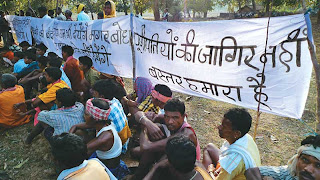 Staying Put: People of Kudur village protest the Bodhghat dam: ‘It does not belong to the capitalists, Bastar is OUrs’y
This legacy of rebellion has left behind a furious people who have been deliberately isolated and marginalised by the Indian government. The Indian Constitution, the moral underpinning of Indian democracy, was adopted by Parliament in 1950. It was a tragic day for tribal people. The Constitution ratified colonial policy and made the State custodian of tribal homelands. Overnight, it turned the entire tribal population into squatters on their own land. It denied them their traditional rights to forest produce, it criminalised a whole way of life. In exchange for the right to vote, it snatched away their right to livelihood and dignity.
Having dispossessed them and pushed them into a downward spiral of indigence, in a cruel sleight of hand, the government began to use their own penury against them. Each time it needed to displace a large population—for dams, irrigation projects, mines—it talked of “bringing tribals into the mainstream” or of giving them “the fruits of modern development”. Of the tens of millions of internally displaced people (more than 30 million by big dams alone), refugees of India’s ‘progress’, the great majority are tribal people. When the government begins to talk of tribal welfare, it’s time to worry.
The most recent expression of concern has come from home minister P. Chidambaram who says he doesn’t want tribal people living in “museum cultures”. The well-being of tribal people didn’t seem to be such a priority during his career as a corporate lawyer, representing the interests of several major mining companies. So it might be an idea to enquire into the basis for his new anxiety.

Therefore, this war.
When a country that calls itself a democracy openly declares war within its borders, what does that war look like? Does the resistance stand a chance? Should it? Who are the Maoists? Are they just violent nihilists foisting an outdated ideology on tribal people, goading them into a hopeless insurrection? What lessons have they learned from their past experience? Is armed struggle intrinsically undemocratic? Is the Sandwich Theory—of ‘ordinary’ tribals being caught in the crossfire between the State and the Maoists—an accurate one? Are ‘Maoists’ and ‘Tribals’ two entirely discrete categories as is being made out? Do their interests converge? Have they learned anything from each other? Have they changed each other?
The day before I left, my mother called, sounding sleepy. “I’ve been thinking,” she said, with a mother’s weird instinct, “what this country needs is revolution.”
An article on the internet says that Israel’s Mossad is training 30 high-ranking Indian police officers in the techniques of targeted assassinations, to render the Maoist organisation “headless”. There’s talk in the press about the new hardware that has been bought from Israel: laser range-finders, thermal imaging equipment and unmanned drones, so popular with the US army. Perfect weapons to use against the poor.
The drive from Raipur to Dantewada takes about 10 hours through areas known to be ‘Maoist-infested’. These are not careless words. ‘Infest/infestation’ implies disease/pests. Diseases must be cured. Pests must be exterminated. Maoists must be wiped out. In these creeping, innocuous ways, the language of genocide has entered our vocabulary.
To protect the highway, security forces have ‘secured’ a narrow bandwidth of forest on either side. Further in, it’s the raj of the ‘Dada log’. The Brothers. The Comrades.
On the outskirts of Raipur, a massive billboard advertises Vedanta (the company our home minister once worked with) Cancer Hospital. In Orissa, where it is mining bauxite, Vedanta is financing a university. In these creeping, innocuous ways, mining corporations enter our imaginations: the Gentle Giants Who Really Care. It’s called CSR, Corporate Social Responsibility. It allows mining companies to be like the legendary actor and former chief minister NTR, who liked to play all the parts in Telugu mythologicals—the good guys and the bad guys, all at once, in the same movie. This CSR masks the outrageous economics that underpins the mining sector in India. For example, according to the recent Lokayukta report for Karnataka, for every tonne of iron ore mined by a private company, the government gets a royalty of Rs 27 and the mining company makes Rs 5,000. In the bauxite and aluminium sector, the figures are even worse. We’re talking about daylight robbery to the tune of billions of dollars. Enough to buy elections, governments, judges, newspapers, TV channels, NGOs and aid agencies. What’s the occasional cancer hospital here or there?
I don’t remember seeing Vedanta’s name on the long list of MoUs signed by the Chhattisgarh government. But I’m twisted enough to suspect that if there’s a cancer hospital, there must be a flat-topped bauxite mountain somewhere.
We pass Kanker, famous for its Counter Terrorism and Jungle Warfare College run by Brigadier B.K. Ponwar, Rumpelstiltskin of this war, charged with the task of turning corrupt, sloppy policemen (straw) into jungle commandos (gold). “Fight a guerrilla like a guerrilla”, the motto of the warfare training school, is painted on the rocks. The men are taught to run, slither, jump on and off air-borne helicopters, ride horses (for some reason), eat snakes and live off the jungle. The brigadier takes great pride in training street dogs to fight ‘terrorists’. Eight hundred policemen graduate from the warfare training school every six weeks. Twenty similar schools are being planned all over India. The police force is gradually being turned into an army. (In Kashmir, it’s the other way around. The army is being turned into a bloated, administrative police force.) Upside down. Inside out. Either way, the Enemy is the People.
It’s late. Jagdalpur is asleep, except for the many hoardings of Rahul Gandhi asking people to join the Youth Congress. He’s been to Bastar twice in recent months but hasn’t said anything much about the war. It’s probably too messy for the People’s Prince to meddle in at this point. His media managers must have put their foot down. The fact that the Salwa Judum—the dreaded, government-sponsored vigilante group responsible for rapes, killings, for burning down villages and driving hundreds of thousands of people from their homes—is led by Mahendra Karma, a Congress MLA, does not get much play in the carefully orchestrated publicity around Rahul Gandhi.
I arrived at the Ma Danteshwari mandir well in time for my appointment (first day, first show). I had my camera, my small coconut and a powdery red tika on my forehead. I wondered if someone was watching me and having a laugh. Within minutes a young boy approached me. He had a cap and a backpack schoolbag. Chipped red nail-polish on his fingernails. No HindiOutlook, no bananas. “Are you the one who’s going in?” he asked me. No Namashkar Guruji. I did not know what to say. He took out a soggy note from his pocket and handed it to me. It said, “Outlook nahin mila (couldn’t find Outlook).”
“And the bananas?”
“I ate them,” he said, “I got hungry.”
He really was a security threat.
His backpack said Charlie Brown—Not your ordinary blockhead. He said his name was Mangtu. I soon learned that Dandakaranya, the forest I was about to enter, was full of people who had many names and fluid identities. It was like balm to me, that idea. How lovely not to be stuck with yourself, to become someone else for a while.
We walked to the bus stand, only a few minutes away from the temple. It was already crowded. Things happened quickly. There were two men on motorbikes. There was no conversation—just a glance of acknowledgment, a shifting of body weight, the revving of engines. I had no idea where we were going. We passed the house of the Superintendent of Police (SP), which I recognised from my last visit. He was a candid man, the SP: “See Ma’am, frankly speaking this problem can’t be solved by us police or military. The problem with these tribals is they don’t understand greed. Unless they become greedy, there’s no hope for us. I have told my boss, remove the force and instead put a TV in every home. Everything will be automatically sorted out.”
In no time at all we were riding out of town. No tail. It was a long ride, three hours by my watch. It ended abruptly in the middle of nowhere, on an empty road with forest on either side. Mangtu got off. I did too. The bikes left, and I picked up my backpack and followed the small internal security threat into the forest. It was a beautiful day. The forest floor was a carpet of gold.
In a while we emerged on the white, sandy banks of a broad flat river. It was obviously monsoon-fed, so now it was more or less a sand flat, at the centre a stream, ankle deep, easy to wade across. Across was ‘Pakistan’. “Out there, ma’am,” the candid SP had said to me, “my boys shoot to kill.” I remembered that as we began to cross. I saw us in a policeman’s rifle-sights—tiny figures in a landscape, easy to pick off. But Mangtu seemed quite unconcerned, and I took my cue from him.
Waiting for us on the other bank, in a lime-green shirt that said Horlicks!, was Chandu. A slightly older security threat. Maybe twenty. He had a lovely smile, a cycle, a jerry can with boiled water and many packets of glucose biscuits for me, from the Party. We caught our breath and began to walk again. The cycle, it turned out, was a red herring. The route was almost entirely non-cycleable. We climbed steep hills and clambered down rocky paths along some pretty precarious ledges. When he couldn’t wheel it, Chandu lifted the cycle and carried it over his head as though it weighed nothing. I began to wonder about his bemused village boy air. I discovered (much later) that he could handle every kind of weapon, “except for an LMG”, he informed me cheerfully.
Three beautiful, sozzled men with flowers in their turbans walked with us for about half an hour, before our paths diverged. At sunset, their shoulder bags began to crow. They had roosters in them, which they had taken to market but hadn’t managed to sell.
Chandu seems to be able to see in the dark. I have to use my torch. The crickets start up and soon there’s an orchestra, a dome of sound over us. I long to look up at the night sky, but I dare not. I have to keep my eyes on the ground. One step at a time. Concentrate.
I hear dogs. But I can’t tell how far away they are. The terrain flattens out. I steal a look at the sky. It makes me ecstatic. I hope we’re going to stop soon. “Soon,” Chandu says. It turns out to be more than an hour. I see silhouettes of enormous trees. We arrive.
The village seems spacious, the houses far away from each other. The house we enter is beautiful. There’s a fire, some people sitting around. More people outside, in the dark. I can’t tell how many. I can just about make them out. A murmur goes around. Lal Salaam Kaamraid(Red Salute, Comrade). Lal Salaam, I say. I’m beyond tired. The lady of the house calls me inside and gives me chicken curry cooked in green beans and some red rice. Fabulous. Her baby is asleep next to me, her silver anklets gleam in the firelight.
After dinner, I unzip my sleeping bag. It’s a strange intrusive sound, the big zip. Someone puts on the radio. BBC Hindi service. The Church of England has withdrawn its funds from Vedanta’s Niyamgiri project, citing environmental degradation and rights violations of the Dongria Kondh tribe. I can hear cowbells, snuffling, shuffling, cattle-farting. All’s well with the world. My eyes close.
---
That was just page 1
7 more will follow in days to come
--
ARUNDHATI ROY
The terse, typewritten note slipped under my door in a sealed envelope confirmed my appointment with India’s Gravest Internal Security Threat. I’d been waiting for months to hear from them. I had to be at the Ma Danteshwari mandir in Dantewada, Chhattisgarh, at any of four given times on two given days. That was to take care of bad weather, punctures, blockades, transport strikes and sheer bad luck. The note said: “Writer should have camera, tika and coconut. Meeter will have cap, Hindi Outlook magazine and bananas. Password: Namashkar Guruji.”
Namashkar Guruji. I wondered whether the Meeter and Greeter would be expecting a man. And whether I should get myself a moustache.
There are many ways to describe Dantewada. It’s an oxymoron. It’s a border town smack in the heart of India. It’s the epicentre of a war. It’s an upside down, inside out town.

n Dantewada, the police wear plain clothes and the rebels wear uniforms. The jail superintendent is in jail. The prisoners are free (three hundred of them escaped from the old town jail two years ago). Women who have been raped are in police custody. The rapists give speeches in the bazaar.
Across the Indravati river, in the area controlled by the Maoists, is the place the police call ‘Pakistan’. There the villages are empty, but the forest is full of people. Children who ought to be in school run wild. In the lovely forest villages, the concrete school buildings have either been blown up and lie in a heap, or they are full of policemen. The deadly war that is unfolding in the jungle is a war that the Government of India is both proud and shy of. Operation Green Hunt has been proclaimed as well as denied. P. Chidambaram, India’s home minister (and CEO of the war), says it does not exist, that it’s a media creation. And yet substantial funds have been allocated to it and tens of thousands of troops are being mobilised for it. Though the theatre of war is in the jungles of Central India, it will have serious consequences for us all.
If ghosts are the lingering spirits of someone, or something, that has ceased to exist, then perhaps the new four-lane highway crashing through the forest is the opposite of a ghost. Perhaps it is the harbinger of what is still to come.
The antagonists in the forest are disparate and unequal in almost every way. On one side is a massive paramilitary force armed with the money, the firepower, the media, and the hubris of an emerging Superpower. On the other, ordinary villagers armed with traditional weapons, backed by a superbly organised, hugely motivated Maoist guerrilla fighting force with an extraordinary and violent history of armed rebellion. The Maoists and the paramilitary are old adversaries and have fought older avatars of each other several times before: Telangana in the ’50s; West Bengal, Bihar, Srikakulam in Andhra Pradesh in the late ’60s and ’70s; and then again in Andhra Pradesh, Bihar and Maharashtra from the ’80s all the way through to the present. They are familiar with each other’s tactics, and have studied each other’s combat manuals closely. Each time, it seemed as though the Maoists (or their previous avatars) had been not just defeated, but literally, physically exterminated. Each time, they have re-emerged, more organised, more determined and more influential than ever. Today once again the insurrection has spread through the mineral-rich forests of Chhattisgarh, Jharkhand, Orissa and West Bengal—homeland to millions of India’s tribal people, dreamland to the corporate world.
It’s easier on the liberal conscience to believe that the war in the forests is a war between the Government of India and the Maoists, who call elections a sham, Parliament a pigsty and have openly declared their intention to overthrow the Indian State. It’s convenient to forget that tribal people in Central India have a history of resistance that predates Mao by centuries. (That’s a truism of course. If they didn’t, they wouldn’t exist.) The Ho, the Oraon, the Kols, the Santhals, the Mundas and the Gonds have all rebelled several times, against the British, against zamindars and moneylenders. The rebellions were cruelly crushed, many thousands killed, but the people were never conquered. Even after Independence, tribal people were at the heart of the first uprising that could be described as Maoist, in Naxalbari village in West Bengal (where the word Naxalite—now used interchangeably with ‘Maoist’—originates). Since then, Naxalite politics has been inextricably entwined with tribal uprisings, which says as much about the tribals as it does about the Naxalites.

This legacy of rebellion has left behind a furious people who have been deliberately isolated and marginalised by the Indian government. The Indian Constitution, the moral underpinning of Indian democracy, was adopted by Parliament in 1950. It was a tragic day for tribal people. The Constitution ratified colonial policy and made the State custodian of tribal homelands. Overnight, it turned the entire tribal population into squatters on their own land. It denied them their traditional rights to forest produce, it criminalised a whole way of life. In exchange for the right to vote, it snatched away their right to livelihood and dignity.
Having dispossessed them and pushed them into a downward spiral of indigence, in a cruel sleight of hand, the government began to use their own penury against them. Each time it needed to displace a large population—for dams, irrigation projects, mines—it talked of “bringing tribals into the mainstream” or of giving them “the fruits of modern development”. Of the tens of millions of internally displaced people (more than 30 million by big dams alone), refugees of India’s ‘progress’, the great majority are tribal people. When the government begins to talk of tribal welfare, it’s time to worry.
The most recent expression of concern has come from home minister P. Chidambaram who says he doesn’t want tribal people living in “museum cultures”. The well-being of tribal people didn’t seem to be such a priority during his career as a corporate lawyer, representing the interests of several major mining companies. So it might be an idea to enquire into the basis for his new anxiety.
The Day of the Bhumkal: Face to face with "India's greatest Security Threat".
Over the past five years or so, the governments of Chhattisgarh, Jharkhand, Orissa and West Bengal have signed hundreds of MoUs with corporate houses, worth several billion dollars, all of them secret, for steel plants, sponge-iron factories, power plants, aluminium refineries, dams and mines. In order for the MoUs to translate into real money, tribal people must be moved.Therefore, this war.
When a country that calls itself a democracy openly declares war within its borders, what does that war look like? Does the resistance stand a chance? Should it? Who are the Maoists? Are they just violent nihilists foisting an outdated ideology on tribal people, goading them into a hopeless insurrection? What lessons have they learned from their past experience? Is armed struggle intrinsically undemocratic? Is the Sandwich Theory—of ‘ordinary’ tribals being caught in the crossfire between the State and the Maoists—an accurate one? Are ‘Maoists’ and ‘Tribals’ two entirely discrete categories as is being made out? Do their interests converge? Have they learned anything from each other? Have they changed each other?
The day before I left, my mother called, sounding sleepy. “I’ve been thinking,” she said, with a mother’s weird instinct, “what this country needs is revolution.”
An article on the internet says that Israel’s Mossad is training 30 high-ranking Indian police officers in the techniques of targeted assassinations, to render the Maoist organisation “headless”. There’s talk in the press about the new hardware that has been bought from Israel: laser range-finders, thermal imaging equipment and unmanned drones, so popular with the US army. Perfect weapons to use against the poor.
The drive from Raipur to Dantewada takes about 10 hours through areas known to be ‘Maoist-infested’. These are not careless words. ‘Infest/infestation’ implies disease/pests. Diseases must be cured. Pests must be exterminated. Maoists must be wiped out. In these creeping, innocuous ways, the language of genocide has entered our vocabulary.
To protect the highway, security forces have ‘secured’ a narrow bandwidth of forest on either side. Further in, it’s the raj of the ‘Dada log’. The Brothers. The Comrades.
On the outskirts of Raipur, a massive billboard advertises Vedanta (the company our home minister once worked with) Cancer Hospital. In Orissa, where it is mining bauxite, Vedanta is financing a university. In these creeping, innocuous ways, mining corporations enter our imaginations: the Gentle Giants Who Really Care. It’s called CSR, Corporate Social Responsibility. It allows mining companies to be like the legendary actor and former chief minister NTR, who liked to play all the parts in Telugu mythologicals—the good guys and the bad guys, all at once, in the same movie. This CSR masks the outrageous economics that underpins the mining sector in India. For example, according to the recent Lokayukta report for Karnataka, for every tonne of iron ore mined by a private company, the government gets a royalty of Rs 27 and the mining company makes Rs 5,000. In the bauxite and aluminium sector, the figures are even worse. We’re talking about daylight robbery to the tune of billions of dollars. Enough to buy elections, governments, judges, newspapers, TV channels, NGOs and aid agencies. What’s the occasional cancer hospital here or there?
I don’t remember seeing Vedanta’s name on the long list of MoUs signed by the Chhattisgarh government. But I’m twisted enough to suspect that if there’s a cancer hospital, there must be a flat-topped bauxite mountain somewhere.
|
It’s late. Jagdalpur is asleep, except for the many hoardings of Rahul Gandhi asking people to join the Youth Congress. He’s been to Bastar twice in recent months but hasn’t said anything much about the war. It’s probably too messy for the People’s Prince to meddle in at this point. His media managers must have put their foot down. The fact that the Salwa Judum—the dreaded, government-sponsored vigilante group responsible for rapes, killings, for burning down villages and driving hundreds of thousands of people from their homes—is led by Mahendra Karma, a Congress MLA, does not get much play in the carefully orchestrated publicity around Rahul Gandhi.
I arrived at the Ma Danteshwari mandir well in time for my appointment (first day, first show). I had my camera, my small coconut and a powdery red tika on my forehead. I wondered if someone was watching me and having a laugh. Within minutes a young boy approached me. He had a cap and a backpack schoolbag. Chipped red nail-polish on his fingernails. No HindiOutlook, no bananas. “Are you the one who’s going in?” he asked me. No Namashkar Guruji. I did not know what to say. He took out a soggy note from his pocket and handed it to me. It said, “Outlook nahin mila (couldn’t find Outlook).”
“And the bananas?”
“I ate them,” he said, “I got hungry.”
He really was a security threat.
His backpack said Charlie Brown—Not your ordinary blockhead. He said his name was Mangtu. I soon learned that Dandakaranya, the forest I was about to enter, was full of people who had many names and fluid identities. It was like balm to me, that idea. How lovely not to be stuck with yourself, to become someone else for a while.
|
In no time at all we were riding out of town. No tail. It was a long ride, three hours by my watch. It ended abruptly in the middle of nowhere, on an empty road with forest on either side. Mangtu got off. I did too. The bikes left, and I picked up my backpack and followed the small internal security threat into the forest. It was a beautiful day. The forest floor was a carpet of gold.
In a while we emerged on the white, sandy banks of a broad flat river. It was obviously monsoon-fed, so now it was more or less a sand flat, at the centre a stream, ankle deep, easy to wade across. Across was ‘Pakistan’. “Out there, ma’am,” the candid SP had said to me, “my boys shoot to kill.” I remembered that as we began to cross. I saw us in a policeman’s rifle-sights—tiny figures in a landscape, easy to pick off. But Mangtu seemed quite unconcerned, and I took my cue from him.
Waiting for us on the other bank, in a lime-green shirt that said Horlicks!, was Chandu. A slightly older security threat. Maybe twenty. He had a lovely smile, a cycle, a jerry can with boiled water and many packets of glucose biscuits for me, from the Party. We caught our breath and began to walk again. The cycle, it turned out, was a red herring. The route was almost entirely non-cycleable. We climbed steep hills and clambered down rocky paths along some pretty precarious ledges. When he couldn’t wheel it, Chandu lifted the cycle and carried it over his head as though it weighed nothing. I began to wonder about his bemused village boy air. I discovered (much later) that he could handle every kind of weapon, “except for an LMG”, he informed me cheerfully.
|
Chandu seems to be able to see in the dark. I have to use my torch. The crickets start up and soon there’s an orchestra, a dome of sound over us. I long to look up at the night sky, but I dare not. I have to keep my eyes on the ground. One step at a time. Concentrate.
I hear dogs. But I can’t tell how far away they are. The terrain flattens out. I steal a look at the sky. It makes me ecstatic. I hope we’re going to stop soon. “Soon,” Chandu says. It turns out to be more than an hour. I see silhouettes of enormous trees. We arrive.
The village seems spacious, the houses far away from each other. The house we enter is beautiful. There’s a fire, some people sitting around. More people outside, in the dark. I can’t tell how many. I can just about make them out. A murmur goes around. Lal Salaam Kaamraid(Red Salute, Comrade). Lal Salaam, I say. I’m beyond tired. The lady of the house calls me inside and gives me chicken curry cooked in green beans and some red rice. Fabulous. Her baby is asleep next to me, her silver anklets gleam in the firelight.
After dinner, I unzip my sleeping bag. It’s a strange intrusive sound, the big zip. Someone puts on the radio. BBC Hindi service. The Church of England has withdrawn its funds from Vedanta’s Niyamgiri project, citing environmental degradation and rights violations of the Dongria Kondh tribe. I can hear cowbells, snuffling, shuffling, cattle-farting. All’s well with the world. My eyes close.
---
That was just page 1
7 more will follow in days to come
--
Subscribe to:
Posts (Atom)